
Regret Is A Prison
How to avoid getting stuck in the past and move on from your mistakes

Imagine this scenario:
You are on your way home. You are walking, caught up in your thoughts, figuring out what to do with the rest of the day. Suddenly, a cloaked figure appears and blocks your path. This is ominous; you have no idea who it is.
The mysterious figure reaches out and hands you a package.
While doing so, you get a short glance at their face. You recognize that the person looks like you, but way older. They say nothing. As you take the package, they disappear, never to be seen again.
All you are left with is confusion and this weird package. What the hell just happened?
You rush home and unpack it. In there, you find a strange device and a note.
“This device lets you undo your mistakes. Instructions are attached. I leave it up to you how you use it - Future You.”
What would you do?
Travel through the past and undo every mistake you have ever made?
Only prevent the really bad events?
Sell access to it for others and have the most profitable product in the world?
1. The point of regret
We all know that mistakes are part of life.
But some hurt way more than others. It’s the lingering regret that we could have acted better in that situation. The pain of letting someone down. That we should have spent more time making a better decision. Or simply using the power of hindsight to undo something horrible.
Regret pushes you to play out all those scenarios in your head. And it can become a prison, keeping you trapped in past events, preventing you from enjoying the present moment.
The problem is, none of it matters. There is no way to undo the past. Time travel is fiction, and if it is even possible, we won’t see it happen in our lifetimes. As soon as a moment has happened, it is in the past. It only exists in your memory.
So what is the point of regret?
Endless suffering about something we have no way of changing?
Let’s look at grief.
Grief is an emotion we feel when we lose something important to us.
When in the process of grieving, we go through a lot of pain. And if you are familiar with them, there are multiple stages of grief:
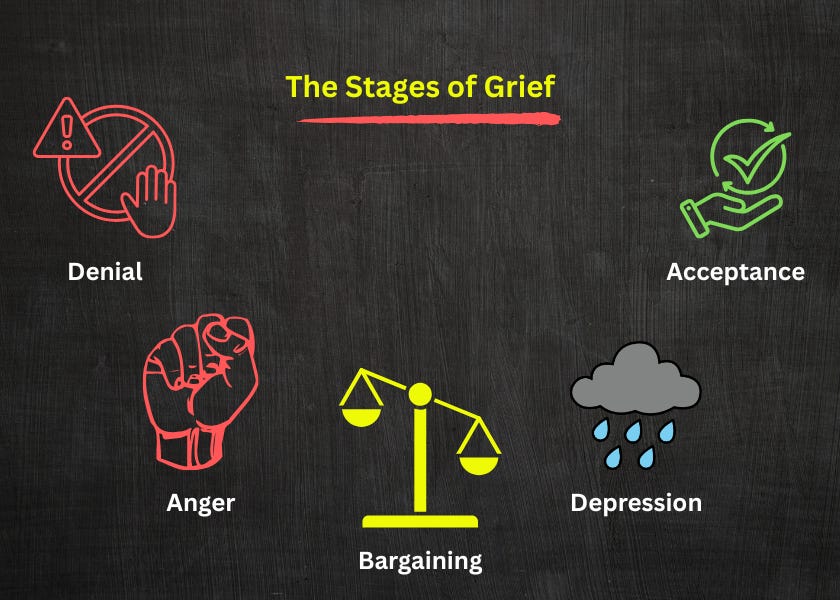
Showing that it is a process. And it also shows us that the goal of grief is not to undo the past or return what we have lost, but to reach the stage of acceptance.
The moment when the pain dissolves, and we can finally return to living a normal life.
Regret is similar.
You can even argue that regret is part of grief. Or that when regretting something, we go through the stages of grief.
The goal is to find a way to move on and for the pain to disappear.
2. How to reach acceptance?
There is never just one way to reach the point of acceptance.
It will look different for everyone.
Since the painful emotion of regret is created by your brain, it is also your brain that will decide when to stop it.
But while the way to get there is different for everyone, the objective of your brain is fairly clear. The brain wants to avoid danger. It wants you to look at your mistakes and learn from them so they don’t happen again.
Regret is a way for your brain to encourage you to do so.
Which is what happens during regret. Replaying the scenario, thinking about what else you could have done. The problem is that we can get stuck in that stage. Similar to grief, we can be chained to the past events, never reaching a conclusion and moving on from them.
This is where regret becomes so painful that we’d rather have a time machine to undo our mistakes than anything else (and then erase all our memory on top of that)
So the main goal is not getting stuck in the past.
Which is a conundrum. Because the past only exists in your memory. A recollection of fragments about what you experienced. Memory is never a 100% accurate version of what happened. You might be missing pieces of it. Or the way the memory was formed only shows one perspective (usually the most negative one) and none of the others.
Regret becomes less about dealing with the past but rather your memorized version of it.
This means there are 2 aspects to it:
Is it real?
You can’t blindly trust your memory. You need to verify it. For example: If you regret hurting someone else, why do you feel that way? Did they tell you that your actions hurt them, or did your mind jump to that conclusion?
The goal is not to gaslight yourself but to make sure what you feel pain about actually happened. Because more often than not, the foundation of regret is faulty.
Get some more data. And if you conclude that your memory is correct, you can figure out…
How to move on?
We already discussed that we can’t undo the past. However, we can still address our mistakes. If you hurt someone, you can make it up to them. If the mistake is unfixable, you can make sure you understand what happened and prevent it from happening again.
This stage is where perspective is so important. The pain of regret can cloud your judgment and keep you trapped in the past. But despite what happened, you can look at what other outcome your mistakes have caused.
What did you learn from this?
How did you grow through this experience?
I have experienced many terrible things in my life. And even though it took many years to get there, I have realized that no matter how painful they were, they always taught me valuable lessons.
I wouldn’t be the person I am today without those experiences. I wouldn’t have had the opportunity to learn these lessons without mistakes or terrible events.
Everything that happens is neutral. It is only when you add your judgment to it that it becomes good or bad. That’s where we suffer. We frame the outcome as bad when we wanted a different outcome instead.
The frame is subjective. Was the event something that should have never happened, or did it lead to the person you are today? With more experience, wisdom, and appreciation?
If I had a device to undo my mistakes, I would change nothing.
I already went through the pain of my past. Undoing it would simply invalidate what I went through. And the lessons are part of my memory anyway.
And I wouldn’t sell the device to others. I don’t believe in tampering with the past (if you are into time travel stories, you know how messy that gets). I would also enable others to rely on ‘undoing their mistakes’ rather than learning how to live with their actions.
I am at peace with my past. The stage of acceptance where I don’t need to change anything and I don’t feel the pain of what happened. But in order to get there, I had to go through the entire journey. Face all the stages, deal with the pain, learn from it.
Regret is a guide.
It shows you what you still haven’t resolved. Where to get more perspective. Where to adopt a different mindset. Regret is here to teach you that life continues and to make the best of the present. And it will stay as long as necessary to make sure you have learned that lesson. Once you are done, it will simply say goodbye and disappear.
If you are still on that journey, I hope that my words will help you along the way.
You got this!
~ Felix
What’s your relationship with regret? Is it a guide, a prison warden, or something that needs to be suppressed at all costs?
And make sure to subscribe if you want to see more content like this!